If you’re a founder, security lead, or GRC manager trying to plan budgets, sales cycles, and engineering effort, this guide breaks down the SOC 2 audit timeline phase by phase—from initial planning to receiving your SOC 2 certification report.
Why Your SOC 2 Timeline Varies
Your exact timeline depends less on the calendar and more on control readiness on day one. Key variables:
- Starting maturity: Do you already have access reviews, change management, incident response, vendor risk, etc.?scrut+1
- Scope: Number of systems, environments, locations, and third parties in scope.
- Report type: Type I (point-in-time design) vs Type II (operating effectiveness over time).
- Auditor capacity: Scheduling fieldwork and report issuance can add weeks.
- Remediation speed: How quickly you close gaps found in readiness assessment.juanidrovo+1
Understanding these factors helps you set realistic expectations with leadership and customers.
SOC 2 Report Types and Their Impact on Timeline
| Factor | SOC 2 Type I | SOC 2 Type II |
|---|---|---|
| What it tests | Control design at a point in time | Control operating effectiveness over a period |
| Typical observation period | None (snapshot) | 3–12 months (6 months common for first audit) |
| End-to-end timeline (first-time) | ~3–6 months | ~6–12+ months (often 9–15 months from scratch) |
| Fieldwork & reporting | ~2–6 weeks | ~6–8+ weeks after observation |
| What buyers usually want | Early-stage validation, internal milestone | Enterprise procurement, recurring assurance |
Many companies do Type I first to show progress, then move to Type II once controls have run for 3–6+ months.
Phase 0: Pre-Planning (1–2 Weeks)
Goal: Align stakeholders, pick report type, and choose an auditor.
Activities:
- Confirm business drivers: customer contracts, procurement requirements, risk program maturity.
- Decide Type I vs Type II based on sales cycles and control maturity.
- Shortlist CPA firms with SaaS/tech experience; request proposals and timelines.
- Appoint an internal SOC 2 owner (security/GRC lead) and define a lightweight steering group (CTO, HR, Legal/Privacy, IT).
Output: Approved project charter, target report type, auditor shortlist, and rough budget.
Phase 1: Scoping & Readiness Assessment (2–6 Weeks)
Goal: Define in-scope systems and measure gaps against SOC 2 Trust Services Criteria (TSC).
Activities:
- Define system boundary: applications, infrastructure, data flows, third parties, and locations.
- Select Trust Services Criteria: Security (required) plus any of Availability, Confidentiality, Processing Integrity, Privacy as needed.
- Run a readiness assessment (internal or via auditor/consultant) to map current controls to TSC and identify gaps.juanidrovo+1
- Prioritize gaps by risk and effort; create a remediation backlog.
Typical duration:
- Mature startups: 2–3 weeks
- Teams building from scratch: 4–6 weeks
Output: Scope document, control matrix, gap list, and remediation plan with owners and dates.juanidrovo+1
Phase 2: Control Design & Implementation (4–12 Weeks)
Goal: Design and implement controls that meet SOC 2 requirements and are evidence-ready.
Common control domains you’ll touch:
- Access management: onboarding/offboarding, MFA, least privilege, periodic access reviews.secureleap+1
- Change management: code review, approvals, CI/CD controls, production access restrictions.
- Security operations: logging, monitoring, vulnerability management, patching.
- Incident response: defined process, roles, comms, post-incident reviews.
- Vendor risk: due diligence, contracts, ongoing monitoring for critical providers.
- HR security: background checks (where applicable), security training, acceptable use.
- Business continuity / DR: RTO/RPO, backups, restore testing.
Implementation tips to compress timeline:
- Use automation/GRC tools for evidence collection (access logs, ticket workflows, training records).
- Reuse existing policies; tailor instead of writing from scratch.
- Align controls with how you already work (e.g., Jira/ServiceNow workflows, GitHub/GitLab PR rules).
Typical duration:
- If you already have a security program: 4–6 weeks
- From near-zero: 8–12 weeks
Output: Implemented controls, updated policies/procedures, and an evidence repository ready for audit.juanidrovo+1
Phase 3: Observation Period (Type II Only) – 3 to 12 Months
Goal: Let controls operate consistently and accumulate evidence over time.
Key points:
- For a first Type II, 6 months is the common minimum observation period; some auditors accept 3 months, others prefer 9–12.secureleap+2
- During this period, you must show controls are consistently applied, not just documented.
- Run quarterly control reviews: access reviews, vulnerability scans, backup/restore tests, incident tabletop exercises.
- Continuously collect evidence: logs, tickets, change records, training completions, vendor assessments.juanidrovo+1
Practical timeline patterns:
- Fast-track Type II: 3–4 months readiness + 6 months observation + 6–8 weeks fieldwork/report ≈ 9–12 months total.
- More conservative: 4–6 months readiness + 9–12 months observation ≈ 12–18 months total.
Output: A full period of operating evidence demonstrating effective controls.
Phase 4: Audit Fieldwork (2–8 Weeks)
Goal: Auditor tests design (Type I) and/or operating effectiveness (Type II) and gathers evidence.
What happens:
- Kickoff call: Confirm scope, criteria, timelines, and evidence formats.soc2auditors+1
- Document requests: Auditor issues a list of policies, procedures, and evidence samples.
- Interviews & walkthroughs: Security, engineering, HR, IT, and sometimes finance/legal.
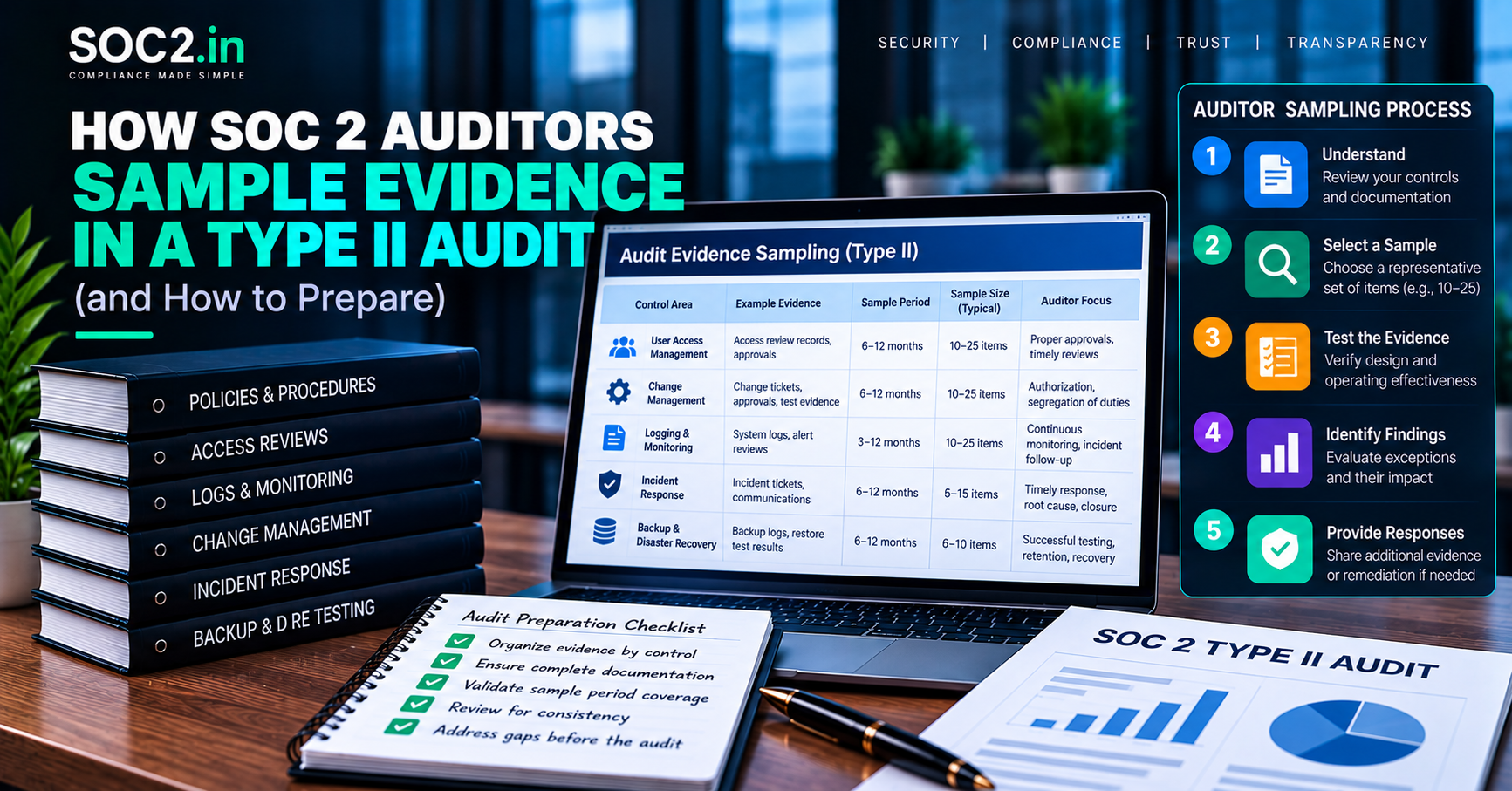
- Testing: Sampling access changes, change tickets, incidents, backups, vendor reviews, etc.soc2auditors+1
Duration:
- Type I: often 2–4 weeks of active fieldwork once you’re ready.
- Type II: commonly 6–8 weeks, depending on scope and sample sizes.
Delays usually come from missing evidence, unclear ownership, or slow responses—not from the auditor’s calendar alone.platops
Output: Auditor working papers, draft findings, and (if any) exceptions or recommendations.
Phase 5: Report Issuance & Certification (1–4 Weeks)
Goal: Receive your SOC 2 report and plan next steps.
Process:
- Auditor finalizes the report, including:
- Management’s assertion
- Auditor’s opinion
- Description of the system
- Tests of controls and results
- Any exceptions or findings
- You receive the SOC 2 report (Type I or Type II) and can share it under NDA with customers and prospects.
Timeline:
- Report drafting and issuance typically takes 1–3 weeks after fieldwork wraps, sometimes up to 4 weeks for complex scopes.soc2auditors+1
Output: Signed SOC 2 report, internal debrief, and remediation plan for any findings.
After Certification: Maintaining and Renewing SOC 2
SOC 2 is not “one and done.” To keep value and meet buyer expectations:
- Type I: Often a stepping stone; plan a Type II within 6–12 months.
- Type II: Typically renewed annually, with a new 6–12 month observation period each cycle.
- Maintain continuous control monitoring so each renewal is smoother and cheaper.
- Update your system description when you add major products, regions, or infrastructure.
Example Timelines: Type I vs Type II (First-Time)
Example A: First SOC 2 Type I (~4–5 Months)
- Weeks 1–2: Pre-planning & auditor selection
- Weeks 3–6: Scoping & readiness assessment
- Weeks 7–14: Control design & implementation
- Weeks 15–18: Audit fieldwork & report issuance
Total: ~4–5 months from decision to signed Type I report.scrut+2
Example B: First SOC 2 Type II (~9–12 Months)
- Weeks 1–4: Pre-planning & readiness assessment
- Weeks 5–12: Control implementation
- Weeks 13–34: 6-month observation period (controls running, evidence accumulating)
- Weeks 35–42: Audit fieldwork & report issuance
Total: ~9–10 months in a “fast but realistic” scenario; 12+ months if starting from low maturity.secureleap+1
Common Timeline Killers (and How to Avoid Them)
- Unclear scope: Too many systems or vague boundaries.
→ Define a tight, defensible system boundary early. - Missing evidence: Controls exist but aren’t documented or logged.
→ Implement evidence-friendly workflows and tooling from day one.scrut+1 - Slow remediation: Gaps identified but not prioritized or owned.juanidrovo+1
→ Use a simple backlog with owners, due dates, and status. - Late auditor engagement: Booking fieldwork too late extends the timeline.
→ Engage auditors during or right after readiness assessment.
FAQs: SOC 2 Audit Timeline
How long does SOC 2 take for a startup?
For a typical SaaS startup with some existing security practices, expect 3–6 months for Type I and 6–12+ months for Type II, depending on readiness and observation period length.scrut+2
Can I do SOC 2 Type II without doing Type I first?
Yes. Type I is optional. Many teams go straight to Type II if they already have mature controls and a clear timeline for an observation period.
What is the shortest realistic SOC 2 Type II timeline?
In aggressive but realistic scenarios, teams complete a first Type II in 9–10 months: ~3–4 months of readiness and implementation, 6 months observation, and 6–8 weeks of fieldwork and reporting.
Does SOC 2 “expire”?
SOC 2 reports don’t technically expire, but customers usually expect a Type II report no older than 12 months. To stay marketable, most companies renew annually.