Preparing for a SOC 2 audit can feel overwhelming. This is especially true if your organization is going through the process for the first time.
You may have security policies, access controls, employee training, cloud security, monitoring, and vendor management already in place. But how do you know whether those controls are actually ready for a SOC 2 examination?
That’s where a SOC 2 readiness assessment comes in.
A readiness assessment helps you identify gaps before the formal audit begins. It gives your team an opportunity to review the scope, controls, documentation, evidence, and processes and fix problems before they become audit issues.
This guide provides a practical SOC 2 readiness assessment checklist that growing businesses can use to evaluate their audit readiness.
What Is a SOC 2 Readiness Assessment?
A SOC 2 readiness assessment is a review performed before the formal SOC 2 examination to determine whether an organization’s controls are appropriately designed, implemented, documented, and operating as expected.
There are two common approaches:
1. Internal SOC 2 Self-Assessment
Your internal security, compliance, IT, or GRC team evaluates the organization’s controls and identifies gaps.
This approach is useful for an initial internal review and can be performed before engaging an external auditor.
2. Formal SOC 2 Readiness Assessment
An external qualified auditor evaluates your readiness before the actual examination.
This is essentially a practice assessment that can identify areas requiring remediation before the formal engagement.
The distinction between an internal self-assessment and an external readiness assessment is also highlighted in Vanta’s current SOC 2 guidance.
Why Should You Perform a SOC 2 Readiness Assessment?
A readiness assessment helps answer one important question:
“Are we actually ready for the SOC 2 audit?”
It can help your organization:
- Identify control gaps
- Find missing documentation
- Discover missing evidence
- Review security processes
- Assign control ownership
- Improve access management
- Strengthen vendor management
- Prepare employees
- Reduce audit surprises
- Improve audit efficiency
The goal isn’t simply to check boxes. The goal is to identify weaknesses while there is still time to fix them.
SOC 2 Readiness Assessment Checklist
Use the following checklist as a practical starting point.
1. Define Your SOC 2 Scope
Before reviewing controls, determine exactly what will be included in the examination.
Check:
- Services included in the audit are identified
- Products in scope are documented
- Production systems are identified
- Applications are identified
- Databases are identified
- Cloud infrastructure is identified
- Data flows are documented
- Employees and teams supporting the service are identified
- Third-party service providers are identified
- Sub-service organizations are considered
Why this matters
An unclear scope can lead to unnecessary work or leave important systems outside your compliance program.
2. Select Your Trust Services Criteria
The AICPA Trust Services Criteria cover:
- Security
- Availability
- Processing Integrity
- Confidentiality
- Privacy
Security is the foundation of a SOC 2 examination. The other criteria should be included when they are relevant to your services, commitments, and business model. The AICPA’s current Trust Services Criteria are the 2017 criteria with revised Points of Focus published in 2022.
Ask:
- Is Security applicable?
- Is Availability applicable?
- Is Confidentiality applicable?
- Is Processing Integrity applicable?
- Is Privacy applicable?
Don’t automatically include every criterion. Define the scope based on what your organization actually does.
3. Decide Between SOC 2 Type I and Type II
Your readiness assessment should also establish which report you’re pursuing.
SOC 2 Type I
Type I evaluates whether relevant controls are suitably designed and implemented at a specified point in time.
SOC 2 Type II
Type II also evaluates whether those controls operated effectively over a defined examination period.
If you’re targeting Type II, your readiness process needs to focus heavily on consistent control operation and evidence collection over time.
Ask:
- Have we selected Type I or Type II?
- Does the choice meet customer expectations?
- Do we understand the examination period?
- Are recurring controls already operating?
- Are we collecting evidence consistently?
4. Review the Control Environment
Review whether your organization has appropriate governance and accountability.
Check:
- Security responsibilities are defined
- Management supports security objectives
- Security policies are approved
- Employees understand their responsibilities
- Control owners are assigned
- Security risks are communicated
- Security activities are monitored
A SOC 2 program should have clear accountability rather than being owned by one person alone.
5. Review Risk Management
Your organization should have a structured way to identify and manage security risks.
Check:
- Risk assessment is documented
- Risk register is maintained
- Risks have owners
- Risks are prioritized
- Risk treatment is documented
- Risk acceptance is documented where applicable
- Risk assessments are reviewed periodically
- New risks are added when the environment changes
Ask yourself:
If a major security risk appeared today, would we know who owns it and what action should be taken?
6. Review Access Controls
Access management is one of the most important areas of SOC 2 readiness.
Check:
- MFA is implemented where appropriate
- Least-privilege access is used
- Role-based access is defined
- User provisioning is documented
- User deprovisioning is documented
- Privileged access is controlled
- Production access is restricted
- Periodic access reviews are performed
- Former employee access is removed promptly
Don’t just confirm that an access policy exists.
Verify that you can produce evidence showing the control actually operates.
7. Review Security Monitoring
Your organization should have appropriate visibility into security events.
Check:
- Critical systems generate logs
- Authentication activity is monitored
- Privileged activity is monitored
- Security alerts are reviewed
- Monitoring responsibilities are assigned
- Log retention is defined
- Security events are investigated
- Monitoring evidence is retained
This is where organizations often discover a gap between having security technology and actually operating a security process.
8. Review Change Management
For SaaS and technology companies, change management is particularly important.
Check:
- Changes are documented
- Changes are reviewed
- Changes receive appropriate approval
- Changes are tested where appropriate
- Production deployments are controlled
- Emergency changes are documented
- Deployment records are retained
- Unauthorized changes are investigated
Your development workflow should support your compliance process rather than creating a separate manual process that engineers rarely follow.
9. Review Vulnerability Management
Check whether your organization can identify and address technical weaknesses.
- Vulnerability scanning is performed
- Critical vulnerabilities are prioritized
- Remediation deadlines are defined
- Patch management is documented
- Penetration testing is performed where appropriate
- Findings are tracked
- Exceptions are documented
- Remediation evidence is retained
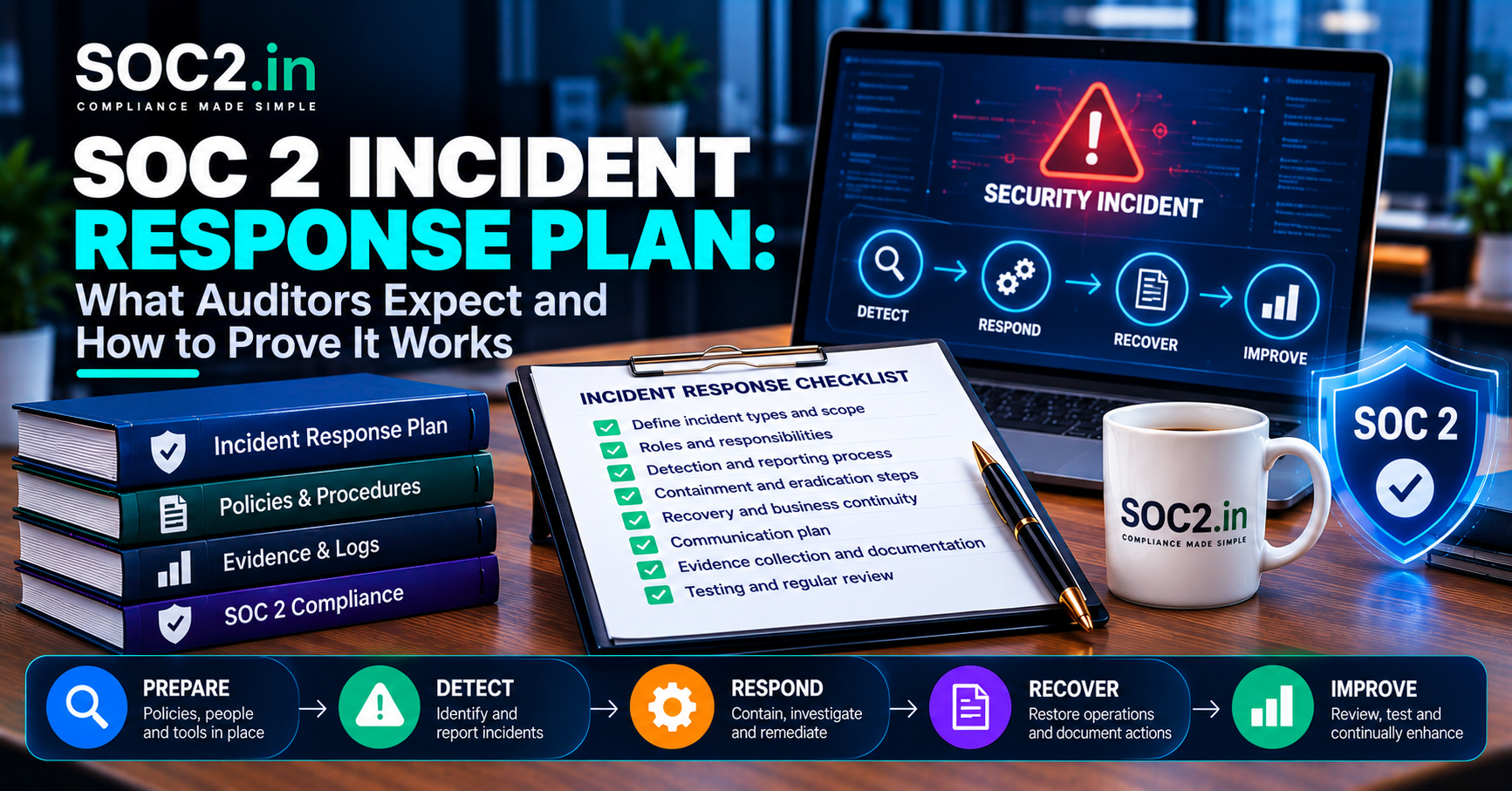
10. Review Incident Response
Your organization should be prepared to respond to security incidents.
Check:
- Incident Response Plan exists
- Incident roles are defined
- Escalation procedures are documented
- Communication procedures are documented
- Incident severity levels are defined
- Incident response is tested
- Lessons learned are documented
- Corrective actions are tracked
A policy sitting in a folder is not enough.
Your team should know what to do when an incident occurs.
11. Review Vendor Risk Management
Your organization probably depends on multiple third parties.
These may include:
- Cloud providers
- SaaS applications
- Payment providers
- Data processors
- Consultants
- Infrastructure providers
- Security providers
Check:
- Vendor inventory exists
- Vendors are risk-rated
- Critical vendors are assessed
- Security questionnaires are reviewed
- Vendor SOC reports are reviewed where appropriate
- Contracts include relevant security requirements
- Vendor reviews are documented
- Vendor risks are tracked
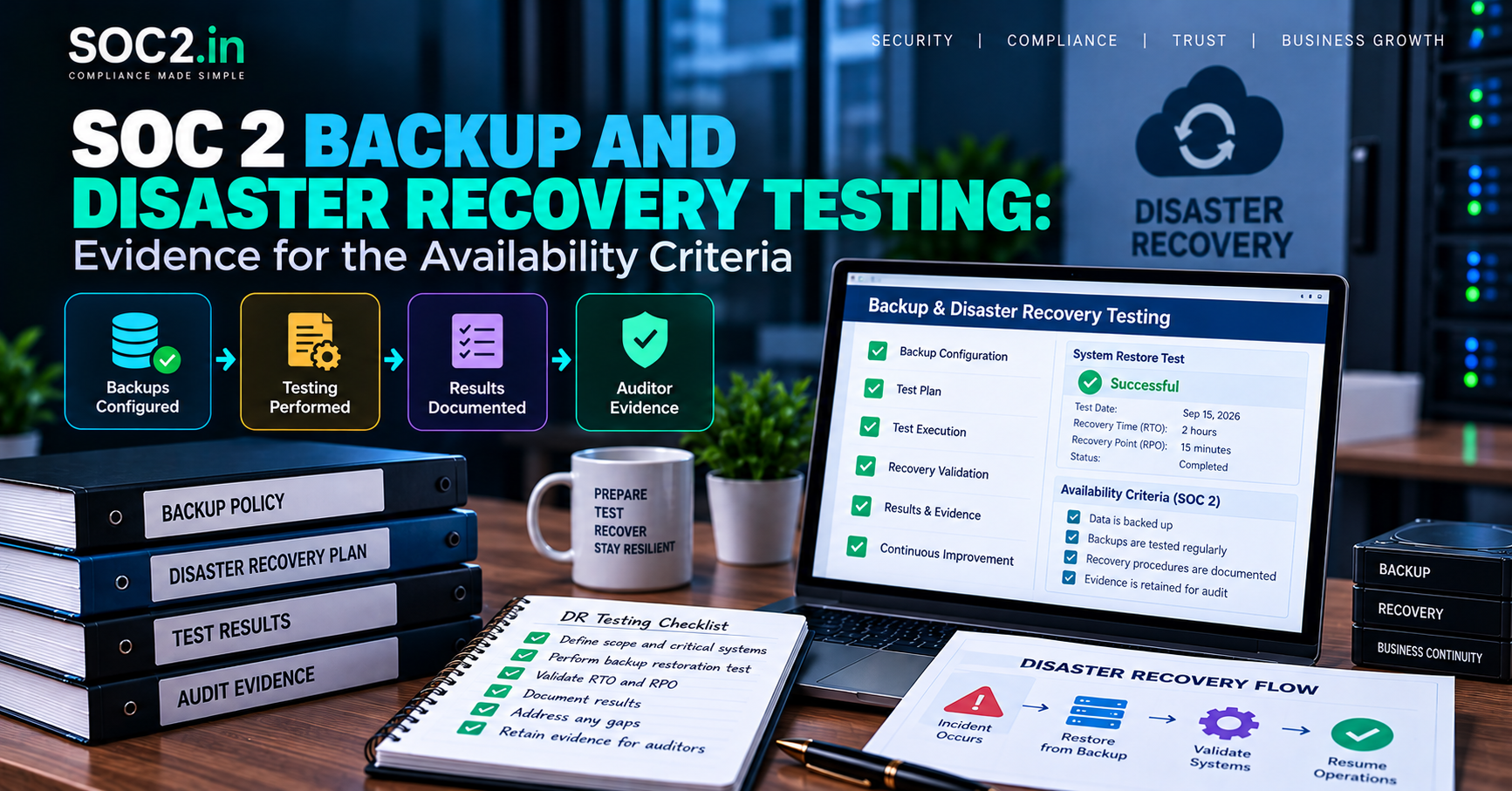
12. Review Business Continuity and Disaster Recovery
If Availability is included in your SOC 2 scope, carefully review your resilience controls.
Check:
- Business Continuity Plan exists
- Disaster Recovery Plan exists
- Backup procedures are documented
- Recovery objectives are defined
- Backups are monitored
- Recovery testing is performed
- Recovery test results are documented
- Issues discovered during testing are remediated
13. Review Employee Security Controls
SOC 2 is not only about technology.
Your employees are part of your control environment.
Check:
- Employee security training is provided
- New employees receive security training
- Refresher training is performed
- Training completion is tracked
- Confidentiality requirements are documented
- Employee onboarding is controlled
- Employee termination procedures exist
- Access removal is linked to termination
14. Review Your SOC 2 Documentation
Your documentation should reflect your actual operations.
Review:
- Information Security Policy
- Access Control Policy
- Change Management Policy
- Incident Response Policy
- Risk Management Policy
- Vendor Management Policy
- Business Continuity Policy
- Disaster Recovery Policy
- Data Classification Policy
- Security Awareness Policy
- Data Retention Policy
- System Description
The AICPA also maintains specific Description Criteria for evaluating a service organization’s description of its system.
15. Review Your Audit Evidence
This is one of the most important parts of the readiness assessment.
For every control, ask:
Does the control exist?
Is it documented?
Is it operating?
Can we prove it?
Evidence could include:
- Access review reports
- Change tickets
- Training records
- Vulnerability reports
- Security logs
- Incident records
- Vendor assessments
- Backup reports
- Risk assessments
- Policy approvals
If the answer to the fourth question is no, you may have an evidence gap.
16. Create a SOC 2 Gap Assessment
After reviewing your controls, create a gap register.
A simple format is:
| Area | Status | Gap | Owner | Priority |
|---|---|---|---|---|
| Access Control | Partial | Quarterly review missing | IT | High |
| Vendor Management | Partial | Critical vendor review incomplete | Compliance | High |
| Incident Response | Complete | No major gap | Security | Low |
| Change Management | Partial | Emergency change process needs improvement | Engineering | Medium |
| Security Training | Complete | No major gap | HR | Low |
This turns your readiness assessment into an actionable project plan.
17. Prioritize Your Gaps
Not every gap deserves the same level of urgency.
A useful classification is:
Critical
Could significantly affect security or audit readiness.
High
Important control weakness requiring prompt remediation.
Medium
Control improvement that should be addressed before the examination.
Low
Documentation or process improvement with limited immediate risk.
Prioritization helps your team focus resources where they matter most.
18. Conduct a Final Readiness Review
Before beginning the formal audit, ask:
- Is our scope finalized?
- Are applicable Trust Services Criteria confirmed?
- Is our Type I or Type II approach confirmed?
- Are all key controls implemented?
- Are control owners assigned?
- Are policies current?
- Is evidence available?
- Are identified gaps remediated?
- Are employees trained?
- Are vendors reviewed?
- Have recurring controls been operating consistently?
- Is our system description accurate?
If several answers are “No,” you’re probably not ready yet.
SOC 2 Readiness: Self-Assessment vs. Formal Assessment
| Feature | Self-Assessment | Formal Readiness Assessment |
|---|---|---|
| Performed by | Internal team | External auditor |
| Cost | Usually lower | Additional professional fees |
| Purpose | Internal gap identification | Independent readiness review |
| Expertise | Depends on internal team | External audit expertise |
| Best use | Early preparation | Pre-audit validation |
| Output | Internal gap list | Formal readiness findings |
A self-assessment can be an excellent first step. A formal readiness assessment can then provide additional independent perspective before the actual examination.
How Long Does SOC 2 Readiness Take?
There is no single timeline that applies to every company.
The timeframe depends on:
- Company size
- Number of systems
- Audit scope
- Existing security maturity
- Number of control gaps
- Availability of evidence
- Type I vs. Type II
- Number of Trust Services Criteria
- Third-party dependencies
The actual audit can take weeks to months depending on scope, audit type, and preparation.
For a Type II examination, organizations also need to maintain effective controls throughout the defined examination period.
SOC 2 Readiness Checklist: Quick Version
Before scheduling your audit, make sure you can check these boxes:
Governance
- Security responsibilities defined
- Control owners assigned
- Security policies approved
Risk
- Risk assessment completed
- Risk register maintained
- Risks assigned to owners
Access
- MFA implemented
- Least privilege enforced
- Access reviews performed
- Terminated users removed
Security
- Vulnerability management
- Security monitoring
- Logging
- Encryption
- Endpoint protection
Operations
- Change management
- Incident response
- Backup and recovery
- Business continuity
Third Parties
- Vendor inventory
- Vendor risk assessments
- Critical vendor reviews
Documentation
- Policies updated
- System description updated
- Procedures documented
- Evidence organized
Audit
- Scope finalized
- Type I or Type II selected
- Readiness gaps remediated
- Evidence available
- Auditor selected
What Happens After a SOC 2 Readiness Assessment?
A readiness assessment should end with action, not just a report.
The typical process is:
Assess → Identify Gaps → Prioritize → Remediate → Test → Collect Evidence → Reassess → Audit
For example, if your readiness assessment discovers that quarterly access reviews are missing, the goal is not simply to document the finding.
Your team should:
- Define the access review process.
- Assign an owner.
- Perform the review.
- Document the results.
- Correct inappropriate access.
- Retain evidence.
- Continue performing the review according to the defined frequency.
That’s what turns a compliance gap into an operating control.
Common SOC 2 Readiness Mistakes
Avoid these problems:
Starting Too Late
Give yourself enough time to fix control and evidence gaps.
Treating SOC 2 as a Documentation Exercise
A policy does not replace an operating control.
Ignoring Evidence
If you cannot demonstrate that a control operated, you may have an audit problem.
Making the Scope Too Broad
Only include systems and services that genuinely need to be examined.
Assigning Everything to IT
SOC 2 involves security, HR, engineering, management, operations, and other functions.
Preparing Only for the Audit Date
For Type II, controls need to operate throughout the examination period.
Final Thoughts
A SOC 2 readiness assessment gives your organization a chance to find problems before the formal examination does.
The most effective approach is simple:
Know your scope. Understand your controls. Identify your gaps. Fix them. Collect evidence. Test your processes. Then schedule the audit.
Use this SOC 2 Readiness Assessment Checklist as a working document rather than a one-time checklist. Review it regularly as your systems, employees, vendors, products, and security environment change.
The AICPA’s Trust Services Criteria provide the authoritative foundation for evaluating controls related to Security, Availability, Processing Integrity, Confidentiality, and Privacy.
For SOC2.in, this topic should also serve as a strong hub page linking to your detailed articles on SOC 2 controls, documentation, audit evidence, Type I vs. Type II, audit preparation, risk management, access control, incident response, vendor management, and continuous controls monitoring.
Frequently Asked Questions
What is a SOC 2 readiness assessment?
It is a prep-audit evaluation designed to identify gaps in an organization’s SOC 2 controls, documentation, processes, and evidence before the formal examination.
Is a SOC 2 readiness assessment mandatory?
No. A readiness assessment is not itself the SOC 2 examination requirement. However, it can be extremely useful for identifying and fixing gaps before the formal audit.
Who can perform a SOC 2 readiness assessment?
An organization can conduct an internal self-assessment, or it can engage an external qualified auditor or advisor for a formal readiness assessment.
What is checked during SOC 2 readiness?
The assessment can review scope, Trust Services Criteria, policies, access controls, risk management, monitoring, change management, incident response, vendors, documentation, and audit evidence.
Is SOC 2 Type II readiness different from Type I?
Yes. Type II readiness requires particular attention to whether controls are consistently operating and producing evidence throughout the defined examination period.
How do I know if my company is ready for SOC 2?
You should be able to demonstrate that your in-scope controls are implemented, documented, assigned to owners, operating consistently, and supported by appropriate evidence.