One of the first questions organizations ask before starting their compliance journey is, “How long does a SOC 2 audit take?” The answer depends on your organization’s security maturity, existing controls, and whether you’re pursuing a SOC 2 Type I or SOC 2 Type II report.
Understanding the SOC 2 audit timeline helps businesses plan resources, set realistic expectations, and prepare for a successful audit.
What is a SOC 2 Audit?
A SOC 2 audit is an independent assessment conducted by a licensed Certified Public Accountant (CPA) to evaluate whether your organization’s security controls meet the AICPA Trust Services Criteria (TSC):
- Security
- Availability
- Processing Integrity
- Confidentiality
- Privacy
The audit verifies that your controls are properly designed and, for Type II, operating effectively over time.
Typical SOC 2 Audit Timeline
Most organizations complete their SOC 2 journey in 3 to 12 months, depending on their readiness.
| Phase | Estimated Duration |
|---|---|
| Readiness Assessment | 2–4 Weeks |
| Gap Remediation | 4–8 Weeks |
| Policy & Control Implementation | 2–6 Weeks |
| Evidence Collection | Ongoing |
| SOC 2 Type I Audit | 2–4 Weeks |
| SOC 2 Type II Observation Period | 3–12 Months |
| Final Audit Report | 2–4 Weeks |
Phase 1: Readiness Assessment
The first step is identifying whether your organization is prepared for a SOC 2 audit.
Activities include:
- Reviewing existing security controls
- Risk assessment
- Gap analysis
- Defining audit scope
- Selecting applicable Trust Services Criteria
This phase helps avoid delays later in the project.
Phase 2: Gap Remediation
After identifying weaknesses, organizations implement missing controls.
Common improvements include:
- Access management
- Multi-Factor Authentication (MFA)
- Security policies
- Incident response planning
- Vendor risk management
- Backup procedures
- Logging and monitoring
Phase 3: Control Implementation
During this phase, security controls are documented and operational.
Organizations typically:
- Publish security policies
- Train employees
- Configure monitoring tools
- Implement encryption
- Establish change management
- Document operational procedures
Phase 4: Evidence Collection
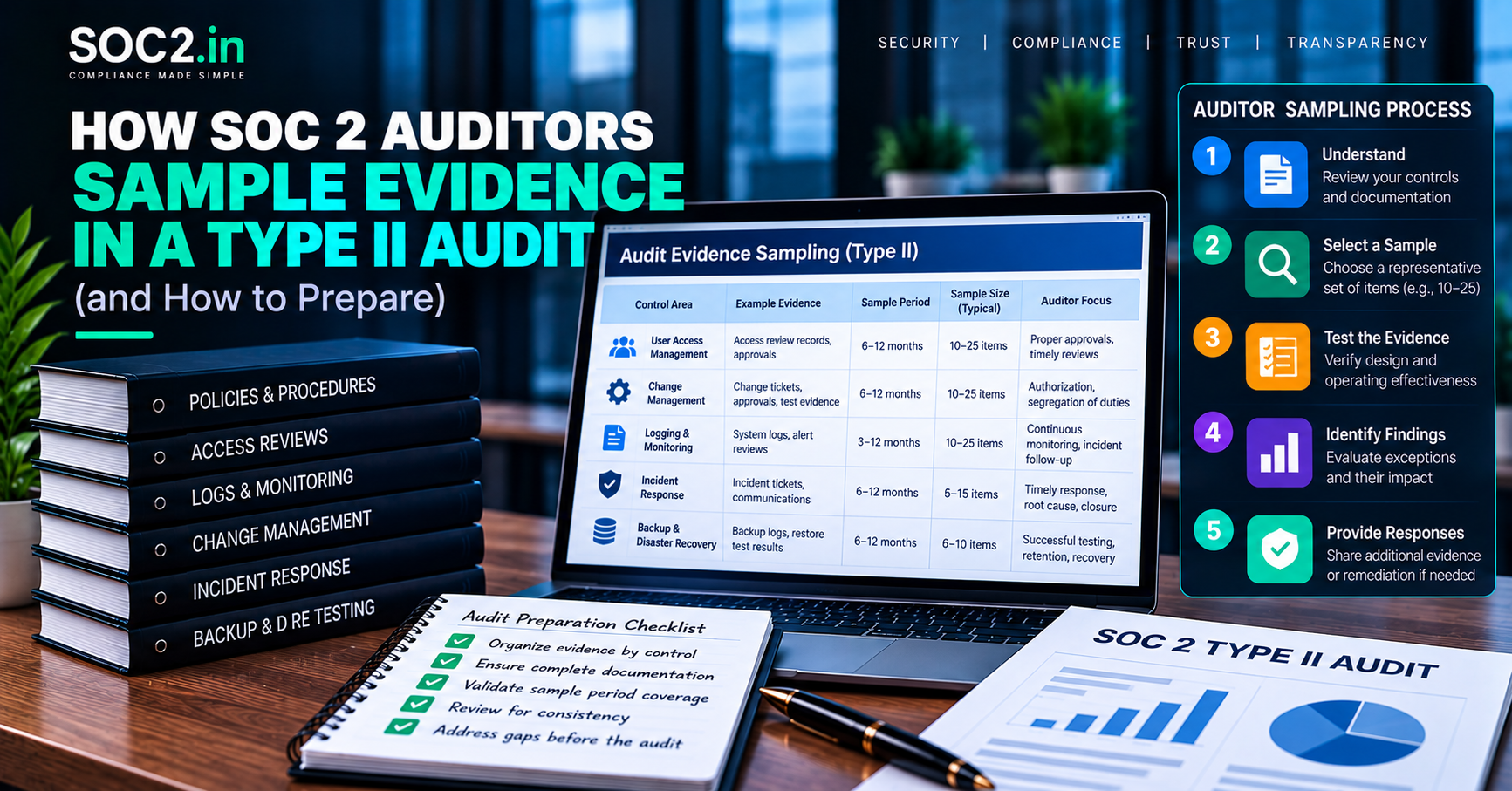
Auditors require evidence demonstrating that controls operate effectively.
Examples include:
- Access logs
- Policy acknowledgements
- Training records
- Vulnerability scan reports
- Backup reports
- Incident response documentation
- Change management records
Organizations should collect evidence continuously rather than waiting until the audit begins.
Phase 5: SOC 2 Type I Audit
The CPA evaluates whether controls are appropriately designed at a specific point in time.
Deliverable:
- SOC 2 Type I Report
Typical duration:
2–4 weeks
Phase 6: SOC 2 Type II Observation Period
For a SOC 2 Type II report, controls must operate effectively over a defined observation period.
Most organizations choose:
- 3 months
- 6 months
- 12 months
Throughout this period, auditors review evidence showing that controls consistently function as intended.
Phase 7: Final Audit Report
Once testing is complete, the CPA issues the final report.
The report includes:
- Audit opinion
- System description
- Trust Services Criteria covered
- Control testing results
- Exceptions (if any)
- Auditor’s conclusion
Factors That Affect the Timeline
Several factors can influence how quickly an organization achieves SOC 2 compliance:
- Existing security maturity
- Number of systems in scope
- Size of the organization
- Availability of audit evidence
- Complexity of cloud infrastructure
- Third-party vendor management
- Employee readiness
- Internal compliance resources
Organizations with mature security programs often complete the process faster.
Tips to Speed Up Your SOC 2 Audit
To reduce delays:
- Perform a readiness assessment early.
- Automate evidence collection where possible.
- Maintain updated security policies.
- Conduct regular risk assessments.
- Monitor controls continuously.
- Train employees before the audit.
- Assign a dedicated compliance owner.
- Work with an experienced SOC 2 consultant.
Conclusion
A successful SOC 2 audit timeline depends on preparation, strong security controls, and continuous compliance. While SOC 2 Type I can often be completed within a few weeks after preparation, SOC 2 Type II requires an observation period that typically ranges from 3 to 12 months.
By planning ahead, addressing security gaps early, and maintaining ongoing evidence, organizations can complete the audit efficiently while strengthening customer trust and improving their overall security posture.
Frequently Asked Questions
How long does a SOC 2 audit take?
Most organizations complete the process in 3 to 12 months, depending on their readiness and whether they pursue Type I or Type II.
What is the difference between Type I and Type II timelines?
Type I evaluates controls at a single point in time, while Type II includes an observation period of 3–12 months to verify operational effectiveness.
Can a startup complete SOC 2 quickly?
Yes. Startups with modern cloud infrastructure and well-documented security controls can often achieve SOC 2 faster than expected.
What is the biggest cause of audit delays?
Incomplete documentation, missing security controls, poor evidence collection, and lack of preparation are the most common reasons for delays.