If you are running a SaaS business in 2026, you have probably already heard one clear message from customers and sales teams.
“Do you have SOC 2?”
That question is not new.
What has changed is how auditors, customers, and procurement teams now evaluate SOC 2 in practice.
The standard itself is still issued by the
American Institute of Certified Public Accountants (AICPA).
However, the way auditors apply SOC 2 to modern SaaS environments has evolved significantly.
In this article, we will focus on what has actually changed for SaaS companies in 2026, not just what the framework says on paper.
SOC 2 is still the same standard, but expectations are not
Formally, SOC 2 is still based on the same Trust Services Criteria.
There is no brand-new version called “SOC 2 2026”.
The real shift is happening in three areas:
- how deeply auditors test cloud environments
- how seriously third-party and vendor risk is evaluated
- how much real operating evidence is required
For SaaS companies, this means audits feel more technical, more continuous, and far more evidence-driven than they did a few years ago.
1. New audit expectations for modern SaaS environments
In earlier years, many SOC 2 audits focused heavily on policies, screenshots, and basic system descriptions.
In 2026, auditors expect to understand how your SaaS platform actually runs.
You will see much deeper testing around:
- production access pathways
- deployment pipelines and release approvals
- separation of duties between developers and operators
- cloud configuration baselines
- incident response workflows in real tools
Auditors are no longer satisfied with simple written explanations.
They now expect to see how controls are enforced directly in your SaaS stack, such as:
- identity platforms
- cloud consoles
- CI/CD pipelines
- ticketing and alerting systems
For SaaS companies, this means engineering and DevOps teams are much more involved in SOC 2 audits than before.
2. Much stronger focus on vendors and cloud services
One of the biggest changes in 2026 is how seriously third-party risk is treated.
Modern SaaS platforms rely heavily on:
- cloud infrastructure providers
- authentication services
- payment processors
- customer support platforms
- analytics and monitoring tools
Auditors now expect your SOC 2 program to clearly answer:
Which vendors can impact the security or availability of your service?
It is no longer enough to simply maintain a vendor list.
In 2026, SaaS companies are expected to demonstrate:
- a formal vendor classification process
- risk assessments for critical suppliers
- security due diligence before onboarding vendors
- periodic reviews of high-risk providers
Cloud services receive special attention.
Auditors increasingly examine:
- your shared responsibility understanding
- your internal controls on top of cloud provider security
- how you monitor misconfigurations and cloud drift
The message is simple.
You are still responsible for your service, even when large parts of it run on someone else’s infrastructure.
3. Stronger and more consistent evidence requirements
Another major shift for SaaS companies is the level of evidence now expected.
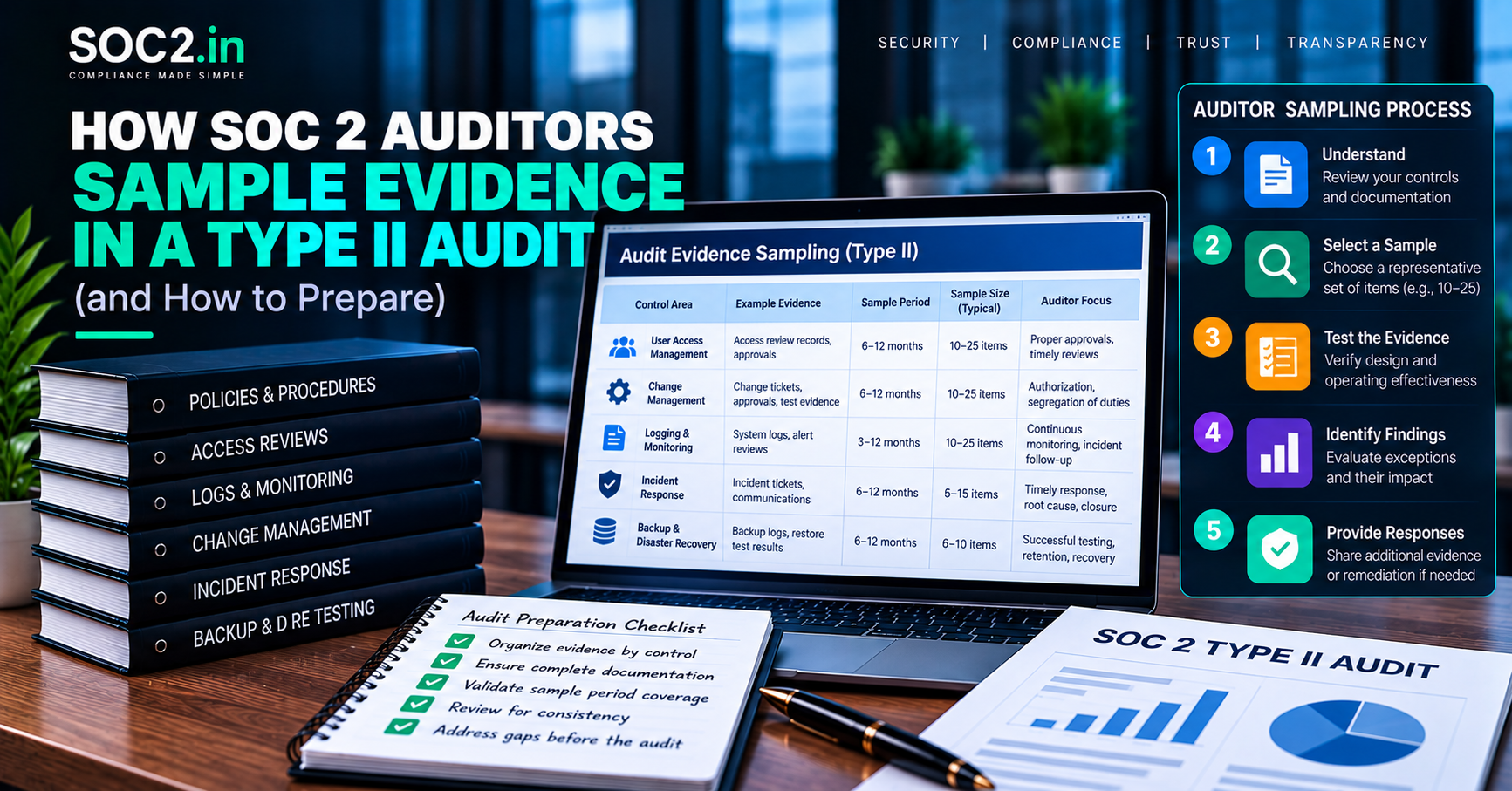
In 2026, auditors are looking for operational proof, not one-time snapshots.
Examples of stronger evidence requirements include:
- access review records for multiple review cycles
- approval trails for production changes across several months
- real incident tickets and investigation logs
- evidence of alert handling and escalation
- proof of policy reviews and management approvals
For SOC 2 Type 2 engagements, auditors expect to see consistency.
They want to confirm that:
- controls were executed every time they were supposed to be
- exceptions were tracked and resolved
- reviews were not skipped during busy release periods
This is particularly important for fast-moving SaaS teams.
If your access review or vulnerability review was skipped for one quarter, auditors will notice.
4. The move toward continuous monitoring
One of the most important trends in SOC 2 for 2026 is the shift away from “audit season”.
SaaS companies are increasingly expected to operate controls continuously.
This includes:
- ongoing access monitoring
- continuous cloud configuration checks
- regular vulnerability scans
- automated evidence collection
- near real-time alerting
From an audit perspective, this changes how readiness is evaluated.
Instead of preparing for audits a few weeks before fieldwork, organizations are expected to be audit-ready all year.
For SaaS companies, continuous monitoring offers two practical benefits:
- fewer surprises during the audit
- less manual work during evidence collection
It also helps teams detect security issues earlier, not only to satisfy auditors but to protect the platform itself.
5. SOC 2 is now closely connected to real sales outcomes
In 2026, SOC 2 has become tightly linked to commercial performance.
Enterprise customers increasingly request:
- SOC 2 Type 2 reports only
- recent reporting periods
- clear descriptions of in-scope systems and services
- confirmation that cloud infrastructure is included
A narrow or outdated SOC 2 scope often creates friction during vendor onboarding.
Many SaaS companies now use SOC 2 scoping strategically to support sales pipelines and enterprise deals.
This commercial pressure has indirectly raised audit expectations.
Auditors are aware that customers rely heavily on the report to make trust decisions.
6. Engineering and operations teams are now core stakeholders
A practical change for SaaS companies is organizational.
SOC 2 in 2026 is no longer driven only by security or compliance teams.
Audits regularly involve:
- platform engineers
- cloud architects
- SRE and operations teams
- release managers
Because controls now live inside cloud platforms and deployment pipelines, auditors expect technical teams to explain:
- how changes are approved
- how access is provisioned
- how alerts are triaged
- how production incidents are handled
For SaaS leaders, this means SOC 2 must be embedded into engineering workflows, not handled as a parallel compliance project.
7. The standard is the same, but audit depth has increased
It is important to be very clear.
SOC 2 is still governed by the same underlying framework defined by the AICPA.
What has evolved is the depth of validation.
Auditors now test:
- how controls operate in real tools
- whether automation is reliable
- whether human approvals are consistently performed
- whether cloud security responsibilities are clearly owned
For SaaS companies, this represents a maturity shift.
SOC 2 is becoming a reflection of operational security practices, not just documentation quality.
Final thoughts
SOC 2 in 2026 has not changed on paper, but it has changed significantly in practice.
For SaaS companies, the biggest differences are:
- deeper technical audit expectations
- much stronger focus on vendors and cloud services
- stricter and more continuous evidence requirements
- growing adoption of continuous monitoring models
Organizations that still treat SOC 2 as a one-time audit project will struggle to keep up.
SaaS companies that build SOC 2 into daily engineering, cloud, and operations workflows are far better positioned to pass audits smoothly and earn customer trust at the same time.