Short answer: The SOC 2 Type II observation period is the stretch of time during which your controls must operate and be tested by the auditor. The AICPA sets no minimum, but most first-time reports cover three to six months, and annual renewals cover twelve. It begins on the date your controls are fully in place and running, not the day you start preparing.
Ask a founder what slows down a first SOC 2 Type II report and the answer is almost always the same: the observation period. You can write policies in a few weeks and configure tools in a few more, but you cannot compress the time during which controls must demonstrably work. Choosing that window well is one of the most useful decisions in the whole project.
This guide explains what the observation period is, how long it should be, when it starts, what can go wrong and how to plan around it.
What is the SOC 2 observation period?
The observation period, also called the audit period, review period or examination period, is the window covered by a Type II report. The auditor tests whether your controls operated effectively across that whole window by sampling evidence from it. A Type I report has no such window because it only looks at the design of controls on a single date.
Your report states the period explicitly, for example “1 April to 30 September”. Customers read that range to decide how much weight to put on the report, and they compare it with their own policies.
How long should the observation period be?
There is no official minimum in the AICPA standards. The length is agreed between you and your auditor, and shaped by what your customers will accept. Three common choices exist:
| Length | Best for | Trade-offs |
|---|---|---|
| 3 months | A first report needed quickly to unblock a deal | Fastest route to a Type II. Some enterprise buyers see it as a thin evidence base. Annual controls may not have occurred yet. |
| 6 months | A balanced first report | Covers more activity and is widely accepted. Takes longer to reach. |
| 12 months | Annual renewals and mature programs | The strongest evidence and the standard for renewals. Too long for a first report if a deal is waiting. |
A common path is a three to six month first report followed by 12-month periods that run back to back. Our guide to the SOC 2 audit timeline shows how the observation period fits into the whole project, and how long a SOC 2 audit takes covers the end-to-end duration.
When does the observation period start?
It starts when your controls are designed, implemented and operating as described. Writing the policy is not enough. If a control began running on 1 June, the period for that control cannot sensibly begin before 1 June, because there is nothing earlier to test.
The practical approach is to finish remediation first, then allow a short stabilization window of a few weeks to confirm that every control is producing evidence. Only then do you lock in the start date. A SOC 2 readiness assessment is the step that finds out which controls are not ready and what to fix before the clock starts.
Why late-starting controls cause problems
If one control starts late, you have three options. You can shift the whole observation period later. You can accept an exception for the part of the period when the control was not running. Or you can narrow the scope. None is ideal, which is why starting the clock only after everything is live saves time overall.
What happens during the observation period
- Controls keep operating. Access reviews, change approvals, vulnerability scans, backups, training and vendor reviews all happen on their normal schedule.
- Evidence accumulates. Tickets, logs, approvals and reports are saved as they are produced. Auditors later sample from the period.
- Business continues. New employees join, systems change and vendors are added. That is expected, but each change must follow your documented process.
- Fieldwork usually follows after the period ends. The auditor requests populations, selects samples and tests them, and then drafts the report. Our overview of what to expect during a Type II audit walks through this stage.
Frequent timing traps
Annual controls in a short period
Some controls only happen once a year, such as a full policy review, a penetration test or a disaster recovery exercise. A three-month period might not contain them at all. Talk to your auditor early about how those will be evidenced so you do not discover the gap at fieldwork.
Starting too early
Teams eager to begin the clock sometimes start before controls are stable. Early failures then appear as exceptions in the report, which you cannot delete later. A few extra weeks of preparation is cheaper than a qualified section in a customer-facing report.
Treating the period as a quiet time
The observation period is when problems surface. A lapsed access review or a missed backup test becomes a documented exception. Assign owners and use reminders so that recurring controls actually recur.
Expecting to extend it afterward
You cannot stretch a completed period to cover more time. If you want a longer window, you decide that at the start or continue into a second period. Report coverage is set by the dates you chose, and the next period should begin immediately so that coverage has no gaps. Our guide on how long a SOC 2 report is valid explains why that matters.
How to choose your observation period
- Ask what your customers require. Look at the vendor risk policies of the buyers driving the project. Some state a minimum period.
- List your annual controls. Decide whether they will fall within a short window and plan their timing.
- Estimate readiness honestly. If you still have remediation open, start the period later, not earlier.
- Agree the dates with your auditor. The auditor must be comfortable that the period gives enough evidence.
- Plan the next period now. Decide whether the next report will follow immediately at 12 months.
Observation period or audit period: are they different?
People use the terms loosely, and they mostly mean the same thing. “Observation period” is common in sales and consulting conversations. “Examination period” or “audit period” appears in reports. The important thing is the exact start and end dates, because that is what a customer reads.
Practical recommendations
- Do not start the clock until every in-scope control has produced at least one clean evidence sample.
- Set calendar reminders for every quarterly and annual control inside the period.
- Collect evidence as you go instead of rebuilding it later.
- If a deal is waiting, ask the customer whether a Type I plus a committed Type II schedule would be acceptable while you build the window.
- Keep your scope tight in the first period, then expand it in later years.
If you want a partner to help plan the dates and keep evidence flowing, SOC2.in provides SOC 2 Type I and Type II audit support. If you are still deciding between the two reports, see SOC 2 Type I vs Type II. For readiness steps before you begin, read our SOC 2 gap analysis guide.
Choosing and managing your observation window
The length of the window is agreed with your auditor, not dictated by a single rule. First-time Type II engagements often use a shorter window than later ones, while renewals commonly cover a full year. The right choice depends on what your customers will accept and how stable your controls are on day one.
Before the window opens
- Confirm every in-scope control is designed, assigned to an owner and actually running.
- Test your evidence capture: can you produce a dated record for a sample day in the first week?
- Finalize policies and get approvals recorded before the start date.
- Agree the start and end dates in writing with the auditor.
While the window is running
- Run a monthly check of recurring controls such as access reviews, backups and vulnerability scans.
- Log and fix any control failure immediately, with a ticket showing what happened and what changed.
- Record changes to systems, vendors or scope, because the system description must stay accurate for the whole period.
If a control fails mid-period
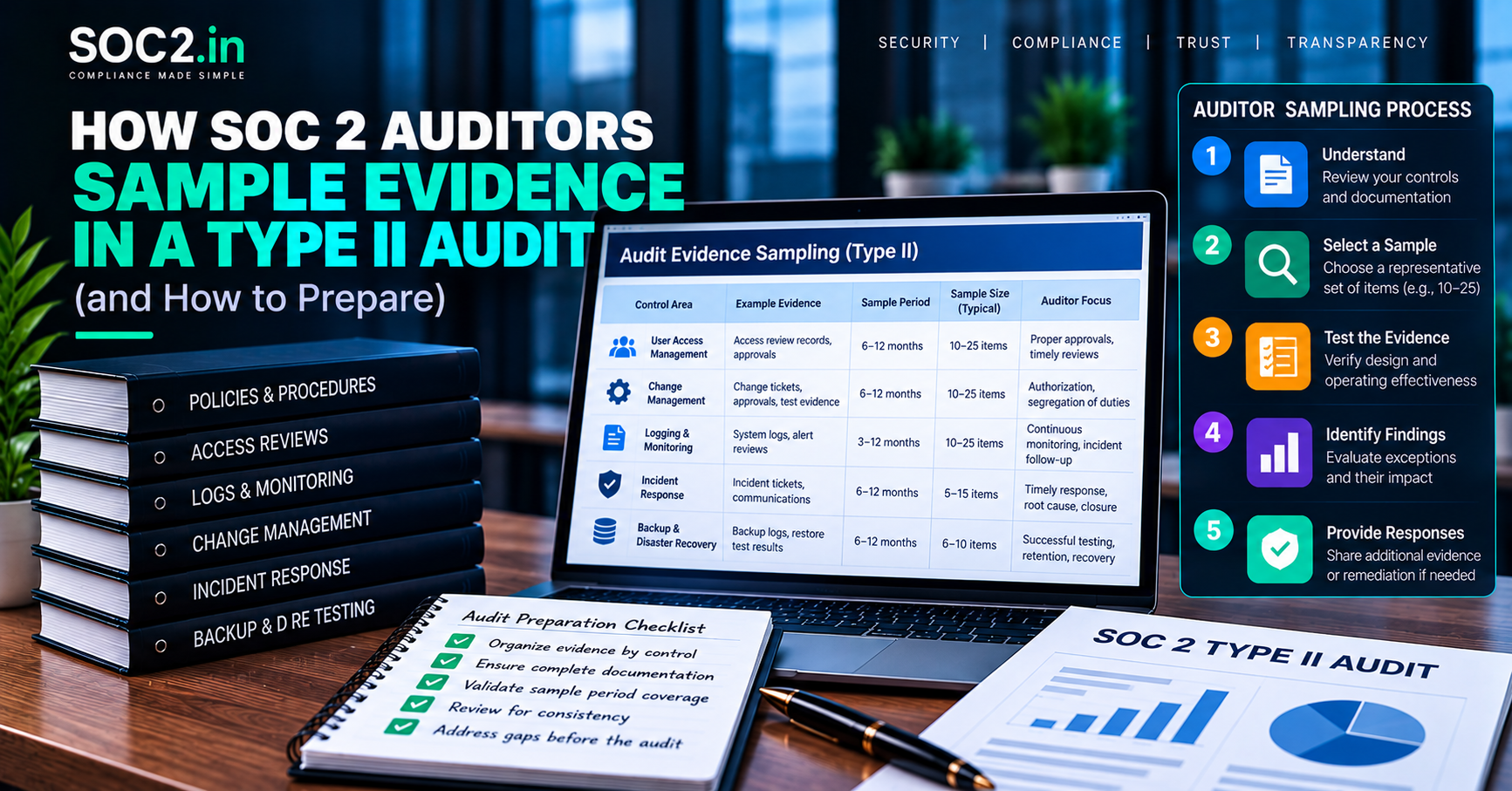
A failure does not automatically end the engagement. The auditor will evaluate whether the issue was isolated, whether a compensating control existed and whether remediation worked. Document everything promptly, because honest, well-documented remediation reads far better than a surprise discovered at fieldwork. For the sampling mechanics that follow, see the way auditors sample evidence.
Frequently asked questions
How long is the observation period for SOC 2 Type II?
It is agreed with your auditor. Three to six months is common for a first report and twelve months is common for renewals. There is no official minimum.
What is the minimum observation period for SOC 2?
The AICPA does not set one. In practice, auditors and customers commonly look for at least three months, and some buyers prefer six.
Can I add employees or change tools during the observation period?
Yes. New hires and changes are normal. Each must follow your documented onboarding and change processes so evidence exists for the samples.
What happens if a control fails during the observation period?
The auditor records an exception when testing the sample. The period does not automatically restart, but the exception appears in the report and may affect the opinion if it is significant.
Can the SOC 2 observation period be extended?
You should choose the length up front. A completed period cannot be stretched, but you can begin a second period right after to keep coverage continuous.
Does a SOC 2 Type I have an observation period?
No. A Type I report looks at the design of controls on a single date, so there is no period to observe.
Conclusion
The observation period is the part of SOC 2 you cannot rush, so the best use of time is to prepare thoroughly before it begins. Start the clock only when controls are live and producing evidence, pick a length your customers will accept, plan for annual controls, and line up the next period before the current one ends.